
Editor’s Note: Moltbook’s AI-only social network is doing more than generating lobster memes—it’s quietly expanding the enterprise attack surface into a place most security and governance programs aren’t watching. When autonomous agents can post, vote, and “socialize” at machine speed—while also holding real permissions to email, calendars, code execution, and corporate files—the line between novelty
Year in Review: 2025 Artificial Intelligence-Privacy Litigation Trends
In 2025, state and federal officials continued scrutinizing the data privacy aspects of artificial intelligence (AI) systems, with enforcement agencies focusing on deceptive marketing claims, opaque data use disclosures, and potential risks to children stemming from chatbots and AI enabled customer interaction tools.
The O2C Acceleration Blueprint: How Mid-Market CFOs Can Cut DSO and Strengthen Cash Flow
Economic uncertainty and sustained periods of expensive capital are prompting CFOs to look inwards for liquidity rather than pursuing external financing or topline expansion. According to the Hackett Group’s 2025 Working Capital Survey, excess Accounts Receivable (AR) alone accounts for nearly $600 billion in tied-up working capital.
What’s more, the gap between top performers
Lawyer 3.0 and the Milkshake Test: Ray Brescia on Legal AI, Client Value, and the Next Wave of Lawyering
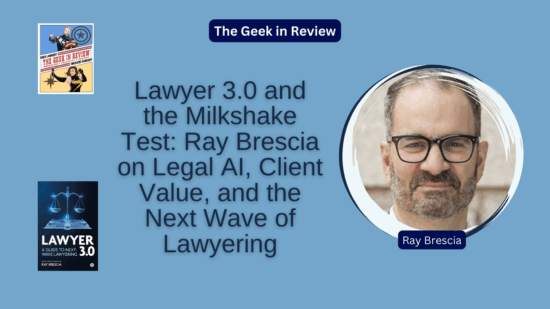
Ray Brescia joins The Geek in Review this week to unpack a role with peak academia vibes, Associate Dean for Research and Intellectual Life at Albany Law School. Greg frames the title as “Chief Curator of Smart People Ideas,” and Ray embraces a “player-coach” approach, coaching faculty scholarship, unblocking stalled projects, and connecting peers across disciplines. The throughline is community, research momentum, and a practical view of how ideas move from draft to impact.
The conversation then pivots to the core thesis of Ray’s book, Lawyer 3.0. Ray maps the legal profession across three eras: Lawyer 1.0 as a low-barrier “amorphous bar,” Lawyer 2.0 as the institutional buildout of law schools, bar exams, ethics codes, and modern law firms, and Lawyer 3.0 as the next inflection point driven by technology. Ray ties prior shifts to urbanization, immigration, and industrial-scale commerce, then parallels those forces with today’s generative AI and analytics reshaping research, drafting, discovery, and service delivery.
Ray retells the famous milkshake study, then translates the idea into legal services: clients are not shopping for “a lawyer,” clients are shopping for problem resolution. This reframing pushes law firms to examine intake, scoping, and service design through the lens of client outcomes, business problems, and life problems, not internal practice labels. The milkshake becomes a metaphor for product-market fit in law, with fewer crumbs on the steering wheel.
Ray contrasts “bespoke services” with productized pathways, including a Model T style offering that meets most client needs at lower cost, plus higher-cost custom work when risk or complexity demands. Ray highlights expert-system style workflows such as Citizenshipworks, describing a TurboTax-like experience for straightforward matters, with “red flags” triggering referral to a lawyer. The same logic extends to limited scope representation and “lawyer for the day” programs in high-volume courts, where informed consent, reasonable scope, and “first, do no harm” reduce the chance of clients feeling abandoned midstream.
The final stretch tackles law firm AI adoption, hallucination risk, and professional responsibility. Ray stresses minimum competence: verify cases, verify quotations, verify sources, and treat generative outputs as drafts or starting points, not final work product. The panel discusses guardrails, education, and workflow design for large firms, plus the rising reality of clients arriving with AI-generated “research.” Ray’s crystal ball points toward more commoditized legal services at scale, a latent market of underserved people, and stronger interdisciplinary collaboration between lawyers and technologists so legal education aligns with Lawyer 3.0 realities.
Listen on mobile platforms: Apple Podcasts | Spotify | YouTube | Substack
[Special Thanks to Legal Technology Hub for their sponsoring this episode.]
Email: geekinreviewpodcast@gmail.com
Music: Jerry David DeCicca
Transcript
Litigation in Lebanon
People have been living in Lebanon for over seven thousand years. It is home to Muslims and Christians, as well as leaders in trade and culture. And so obviously it has been home to some disputes. I have always wanted to visit, both to enjoy some kibbe and arak, but also to learn how litigators
When Bots Start Building Their Own Communities: What OpenClaw and Moltbook Teach Us About AI Autonomy
Welcome back, legal rebels and AI explorers! 🦞⚖️This week, something happened that deserves our full attention. Not because it’s “the singularity” (it’s not), but because it’s a stress test for everything we’ve been theorizing about autonomous AI systems, and the results should concern anyone thinking seriously about where this technology is headed.I’m talking about OpenClaw
Litigation Against Venture Capital in the Unicorn Era
In 2023, a former employee and shareholder of a struggling startup called Teespring sued not just the company and its managers, but also one of its investors: Hydrazine Capital, a venture fund affiliated with OpenAI CEO Sam Altman. The plaintiff won a judgment against the company after it stopped paying him. But when he attempted
A More Efficacious Way to Measure Greenhouse Gas Emissions

As an environmental attorney who spends much of my time advising business owners, I have learned an immutable truth: markets work best when the rules are clear, fair, and grounded in reality. Environmental policy is no exception. Contrary to the prevailing narrative in popular media, the global business community has not uniformly shifted away from
Are you ready for OpenAI to raise $100 BILLION?

The NewYorkTimes.com reported that “OpenAI is in talks with tech giants and Middle Eastern sovereign wealth funds to raise as much as $100 billion in a new round of funding that could value the company at $750 billion or more, according to five people with knowledge of the discussions.” The January 29, 2026 article entitled
Accor Makes Its Move in AI Travel With a New Booking Experience in ChatGPT
Good Sunday afternoon from Manson, Washington . . . Our weekly Online Travel Update for the week ending Friday, January 30, 2026, is below. Accor garnered much of the travel industry’s attention this past week as it became the first lodging supplier to announce the launch of its own ChatGPT mobile app. Other headlines underscore