
I’ve always written under the assumption that people were reading what I put out here and, hopefully, learning something. In the age of AI-slop, I want more of that, and only that. I’m seeking it out and connecting with it. I am not connecting with people who are creating crap content in a chase for
Four Fearless Employment Law Predictions for 2026

For many years, I’ve made predictions on what I think may happen for the upcoming year.
Some years, it was pretty predictable. But, to state the obvious, we’re living through some unpredictable times. Changes at the federal level have come mainly through executive orders and changes in enforcement priorities. It’s been many, many years, since
Request for Four Document Custodians Granted by Court: eDiscovery Case Law
In Andersen v. Stability AI Ltd., California Magistrate Judge Lisa J. Cisneros, finding no abuse of the custodian designation process by Plaintiffs in their request for four document custodians from defendant DeviantArt (DA), granted the Plaintiffs’ request.
The post Request for Four Document Custodians Granted by Court: eDiscovery Case Law appeared first on eDiscovery Today
Bot Overlords, Deepfakes, and the Weight of the Robe: Judge Scott Schlegel on AI in the Courts
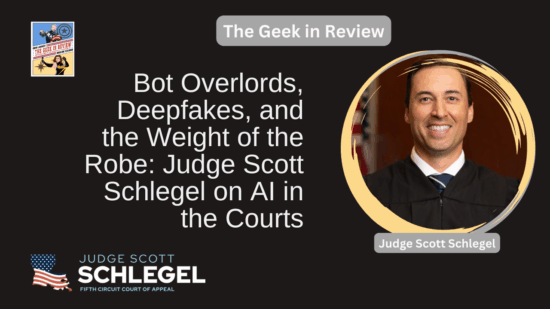
Judge Scott Schlegel of the Louisiana Fifth Circuit Court of Appeal joins The Geek in Review for a candid, funny, and unflinchingly practical conversation about AI inside the judicial system. Schlegel wears multiple hats, appellate judge, former prosecutor, reform-minded builder, plus a podcaster and Substack writer who speaks plainly about what works and what fails when technology hits real people on real timelines. The throughline stays consistent, courts do not need more hype, courts need competence, guardrails, and a process mindset.
Judge Schlegel tackles the messy reality of AI disclosures, certifications, and uneven court rules across jurisdictions. His core message lands fast, judicial authority lives with the judge, not an AI system. From there, he outlines why chambers guidance matters, along with a structured, step-by-step approach for responsible drafting support, including prompt discipline and workflow thinking. The goal stays simple, faster decisions without surrendering judgment to “bot overlords.”
The discussion then shifts to constraints judges live with every day, budgets, procurement rules, security anxiety, and the gap between shiny vendor demos and courthouse reality. Schlegel argues for a scrappy, process-first approach using small pilots, one chambers, one workflow, one measurable result. He compares the moment to early “cloud” adoption lessons, pay for the right security, avoid free tools where the user becomes the product, and treat sensitive records with strict care. Courts will see broader adoption as enterprise-grade options become attainable and baked into trusted platforms.
Then comes the part that lingers in your head after the episode ends, deepfakes and voice cloning as a near-term threat to due process, especially in domestic violence and protective order contexts. Schlegel explains why judges tend to err on the side of safety, and why “damage done” shows up long before expert testimony arrives. His practical recommendation focuses on pretrial practice, require disclosure, surface manipulation concerns early, and reduce surprises at trial. He even shares a simple family safety habit, a private “secret word” to confirm identity during urgent calls, since voice cloning tools lower the barrier for fraud.
Finally, Schlegel offers a sharp warning about confirmation bias, large language models often aim to please the user, which benefits advocates and harms neutral decision-making. His answer: an “AI alignment test” mindset, deliberate prompting, and refusal to outsource the white-page moment to a model. For the future, he points toward structural change courts rarely receive funding for, true legal technologists who redesign case management and public-facing guidance at scale. If courts stop printing emails and living in wire baskets, progress follows, and yes, somewhere in a parallel universe, Schlegel still wants a hologram machine.
Links
Judge Schlegel, his court, and his work
- Judge Schlegel bio page. Judge Scott Schlegel
- Louisiana Fifth Circuit Court of Appeal profile page for Judge Schlegel. Fifth Circuit Court of Appeal
- Judge Schlegel’s Tech & Gavel landing page. Judge Scott Schlegel
- Tech & Gavel on Apple Podcasts. Apple Podcasts
AI-in-courts guidance, plus his newsletter
- “AI in Chambers: A Framework for Judicial AI Use” (includes the download link). Judge Scott Schlegel
- Schlegel Tech Substack newsletter. [sch]Legal Tech Substack
Deepfakes, provenance, and content credentials
- C2PA, Coalition for Content Provenance and Authenticity, “About” page. C2PA
Listen on mobile platforms: Apple Podcasts | Spotify | YouTube
[Special Thanks to Legal Technology Hub for their sponsoring this episode.]
Email: geekinreviewpodcast@gmail.com
Music: Jerry David DeCicca
Transcript
A Pro-Se Claim Goes Down In Possible AI Flame
In Hilpert v 16 Judge SPV LLC 2025 NY Slip Op 34683(U) December 4, 2025Supreme Court, Kings County Docket Number: Index No. 522220/2025Judge: Reginald A. Boddie the pro-se case ends in dismissal, sanctions and a vexatious litigant finding against the pro-se plaintiff. AI research may have had a part.
“Defendant David Koshers, Esq. ‘s motion
Matthew Fornaro: Building a Solo Law Firm in the Age of AI
In this episode, Steve Fretzin and Matthew Fornaro discuss:
- Making solo practice more accessible than ever
- Using AI as a force multiplier for small firms
- Practicing ethical and intentional AI adoption
- Rethinking legal business models and skill sets
Key Takeaways:
- Starting a firm no longer requires a large office, full staff, or major upfront
How General Counsel Can Leverage AI to Create More Value for Their Organizations
I spoke with Eric Greenberg, the Executive Vice President and General Counsel of Cox Media Group, a multi-platform media company based in Atlanta. Eric was a finalist for Corporate Counsel magazine’s General Counsel of the Year in 2024 and 2025 and is the author of an eight-part series on AI in Bloomberg Law
Why Electricity Will Be the Number One Environmental Issue of 2026

Energy, especially electricity, will define environmental law and policy in 2026
Staying Healthy

Obtaining good healthcare is not always easy. Not every doctor is a Marcus Welby clone. And as the old joke goes, 50% of doctors graduated in the lower half of their classes, right? Burnout and pressure to meet daily patient-volume quotas mean many patients don’t receive the attention they deserve and expect.
Lawyers who want
A New Year to Renew: How Sustainability Contributes to Smarter Data Governance
Editor’s Note: A new year brings not just the promise of innovation, but the necessity of renewal—especially in how organizations govern and protect their data. While ESG may no longer be the term du jour, the drive for sustainability is far from fading. For professionals navigating cybersecurity, data privacy, regulatory compliance, and eDiscovery, sustainability is