
Public Employees for Environmental Responsibility (PEER) announced on March 5, 2026, that through counsel at the Free Information Group (FIG), it filed a series of Freedom of Information Act (FOIA) requests with the U.S. Environmental Protection Agency (EPA) “seeking records related to how the agency is deploying artificial intelligence [(AI)] tools within its workforce and
AI in the Exam Room: What WVU Medicine’s Abridge Rollout Means for Physicians
Artificial Intelligence continues to move quickly into the clinical workflow.WVU Medicine recently announced that it is expanding its use of Abridge, an AI-powered transcription platform designed to generate clinical documentation during patient encounters. What began as a small pilot program in 2025 has now grown to more than 1,200 physicians, nurse practitioners, and physician assistants
Zalma’s Insurance Fraud Letter – March 15, 2026
ZIFL – Volume 30, Issue 6
THE SOURCE FOR THE INSURANCE FRAUD PROFESSIONAL
Post number 5304
Zalma’s Insurance Fraud Letter (ZIFL) continues its 30th year of publication dedicated to those involved in reducing the effect of insurance fraud. ZIFL is published 24 times a year by ClaimSchool and is written by Barry Zalma. It is
The Law Bytes Podcast, Episode 261: Ian Goldberg on the Privacy Risks of Age Assurance Technologies
Age verification, estimation or inference is seemingly all the rage right now. Vendors are promoting it as the solution to thorny challenges to limit access to certain sites and services and politicians are eager to legislate in that direction, including in Canada with Bill S-209.
Hundreds of scientists and technology experts from around the
Bribery scandals don’t start with bad employees; they start with bad culture
When a bribery scandal hits a company, the corporate response is almost always the same: These were bad employees acting on their own.

Maybe. But usually not.
Consider the current mess involving Southern Glazer’s Wine & Spirits, the largest alcohol distributor in the United States.
Federal prosecutors have charged several of its former executives in
The Eleventh Circuit Just Gave Us a Roadmap for Using AI to Interpret Insurance Policies — and Coverage Lawyers Should Pay Attention

In this blog series, we explore the promises and the pitfalls of AI tools in the insurance coverage context, offering practical guidance for lawyers and business professionals to harness these technologies without getting burned.
If you practice insurance coverage law, you’ve been there: staring at an undefined term in a policy, toggling between three dictionaries
Weekly Blockchain Monitor – March 16, 2026
In this issue:
- Financial Institutions and Crypto Payments Companies Launch Products, Collaborations
- US Stock Exchanges Announce Initiatives with Crypto Exchanges
- Treasury Issues Report on Innovative Technologies To Combat Illicit Crypto Activities
- Federal Banking Regulators Address Tokenized Securities, Stablecoins
- DOJ Continues Crypto Enforcement Actions
- Report Provides Data on Crypto Illicit Activity in 2025
Financial Institutions and
Anthropic’s Matt Samuels and Den Delimarsky – Claude & MCP: Building the USB-C for the Legal Tech Stack
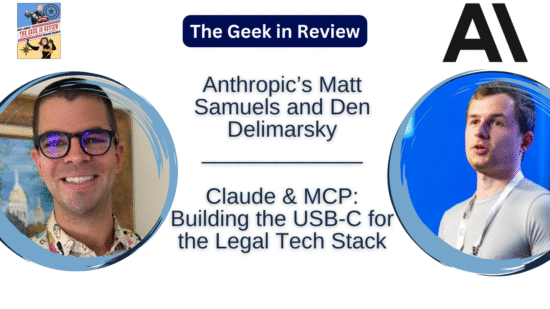
This week, we sit down with two guests from Anthropic, Matt Samuels, Senior Product Counsel, and Den Delimarsky, a core maintainer of the Model Context Protocol, or MCP. Together, they unpack why MCP is drawing so much attention across the legal industry and why some are calling it the USB-C for AI. For law firms long burdened by disconnected systems, scattered data, and the infamous integration tax, MCP offers a shared framework for connecting models to the places where real work and real knowledge live, from iManage and Slack to email, data lakes, and internal tools.
Den explains that the promise of MCP is not tied to one model or one vendor. Instead, it creates a standardized way for AI tools to securely interact with many different systems without forcing organizations to build one-off integrations every time they want to connect a new source. The conversation gets especially relevant for legal listeners when Greg and Marlene press on issues like permissions, ethical walls, least-privilege access, and auditability. The answer from Anthropic is reassuring. MCP is built to work with familiar enterprise security concepts such as OAuth and role-based access, meaning firms do not have to throw out their security model in order to explore new AI workflows.
Matt brings the legal and operational lens, translating MCP into practical use cases for lawyers, legal ops teams, and security leaders. He describes how AI becomes far more useful once it has access to the systems lawyers already rely on every day, while still operating within carefully defined administrative controls. The discussion highlights a key shift in how firms should think about AI. This is no longer about asking a chatbot a clever question and getting a polished paragraph back. With MCP, firms are moving toward systems where AI can retrieve, correlate, summarize, draft, and support actions across multiple platforms, all while staying inside the guardrails set by the organization.
The episode also explores how MCP fits into the rise of agentic workflows, apps, plugins, and skills. Rather than treating AI as a static assistant, Anthropic describes a future where these tools become active participants in legal work, pulling together information from multiple sources, helping assemble case timelines, drafting notes into a shared document, and supporting lawyers in a far more integrated workspace. The conversation around skills is especially useful for firms thinking about standard operating procedures, preferred drafting styles, escalation rules, and repeatable work product. Skills and MCP do different jobs, but together they start to look like the operating system for structured legal workflows.
By the end of the conversation, one message comes through clearly. The legal profession is still early in this shift, but the pace is picking up fast. Both Matt and Den encourage listeners to stop treating these tools like abstract future concepts and start experimenting with them now. At the same time, they offer an important note of caution. As much as these systems promise speed and efficiency, lawyers still need to protect the craft of lawyering, their judgment, and the human choices that matter most. For firms trying to make sense of where AI is headed next, this episode offers a grounded and practical look at the infrastructure layer that could shape what comes next.
Listen on mobile platforms: Apple Podcasts | Spotify | YouTube | Substack
[Special Thanks to Legal Technology Hub for their sponsoring this episode.]
Email: geekinreviewpodcast@gmail.com
Music: Jerry David DeCicca
Transcript
AI-Related Securities Suit Filed Against Israeli Software Company
Among the challenges companies face as they incorporate AI into their business strategies is accurately projecting the impact the AI-based approach will have on their business and financial results. Business outcomes may fall short of expectations to the disappointment of investors, which in turn can lead to securities litigation. In the latest example of this phenomenon, investors sued the Israeli-based software company Monday.com after it adjusted its earnings guidance as its AI-based strategy unfolded differently than the company had projected. A copy of the March 10, 2026, complaint against the company can be found here.
ComplexDiscovery OÜ and EDRM Release Complete Analysis of the Winter 2026 eDiscovery Pricing Survey
Editor’s Note: The Winter 2026 eDiscovery Pricing Survey — the fifteenth edition of ComplexDiscovery’s semi-annual Pricing Pulse research series, conducted in partnership with the Electronic Discovery Reference Model (EDRM) — was published in full on ComplexDiscovery.com on March 6, 2026. This press release represents the formal broader distribution of those findings to the professional and